Popular Posts

Showing posts with label Olympia. Show all posts

Thursday, August 4, 2016

South of the Mason-Dixon line

The U.S.S.Olympia in all its glory at the Independence Seaport Museum in Philadelphia

My son, Anthony, stands ready at one of the U.S.S. Olympia's big guns.

The U.S.S. Becuna straddles the Olympia in Philadelphia.

My wife, Terri, takes a break in Philadelphia.
I am standing in a small cemetery at the Christ Church in Alexandria.

Terri enjoys a moment in Alexandria, Va.

The Carlyle House where PBS's "Mercy Street" is based on during the Civil War.

The three of us stand on the porch of Carlyle House in Alexandria.

Standing on the boardwalk along the Potomac River in Alexandria.


Above and below, some scenes of Washington  D.C.


Scenes of the Smithsonian's Air and Space Museum.


D.C.'s famed Metro in action.


The Belle Plantation in Middletown, Va.


Above, reenactors camp out against the backdrop of the Shenandoah Mountains in Middleton, Va. Below, reenactors return to camp after a battle.


“A vacation is having nothing to do and all day to do it in.” 

                                                                                                                          — Robert Orben


AUBURN, Maine — Pardon me, but my thoughts are somewhere between the Allegheny Mountains of Pennsylvania and the Poconos of New York.

We completed a 1,700-mile roundtrip through 10 states and Washington, D.C. in five days. 

I am still shaking off White Line Fever and have avoided getting behind the wheel of a vehicle the past several days.

The Christ Church in Alexandria. 

I have a new appreciation for cross-country truck drivers who stare endlessly down long roads filled with distracted drivers — who see texting is an opportunity to cause a 25-car pileup on the New Jersey Turnpike.

What started out as a destination to Cedar Creek Battlefield in Middletown, Va., ended up becoming whirlwind tour of Philadelphia, D.C., and Alexandria and Shenandoah Mountains in Stephens City.

It was a hit-and-run effort to see everything possible within five days, which was no easy task for us, especially in the heat.

My son is a Civil War reenactor with the Third Maine. They were up against the Confederates again in the Shenandoah Mountain range at location called Belle Grove Plantation in Middletown.

By the way, the North won. I put all my money on the Blue Bellies.

Along the way, we traveled through Maine, New Hampshire, Massachusetts, Connecticut, New work, Pennsylvania, Maryland, Virginia, West Virginia, Delaware and the District of Columbia.
We weaved our way around and through four stunning mountain ranges: the Shenandoah Valley, Blue Ridge, Alleghenies and the Poconos.

We crossed the mighty Susquehanna, Potomac and Hudson rivers twice and held our breath when we traversed the George Washington Bridge, where confused New York drivers think they are racing at the Brickyard.

The Blasi family sped through the Baltimore Tunnel, crossed the Betsy Ross Bridge into Philadelphia, snaked along the Hudson River Parkway and boarded the fabled Metro system in Washington D.C.

We had the opportunity to the Mason-Dixon line as we raced back to New England. 

The Confederates ran us out of town — those damn Rebs.

It was a spectacular journey that featured numerous national landmarks and people who continually surprised us with their kindness.

There is a lot to be said about southern hospitality — and most of it is true.

My son was my Columbus and Anthony did impeccable job navigating our routes with his GPS and several maps from the backseat of our rented car.

We spent two days in Philly, two in Arlington, Va., and two days in Middletown, Va.

Starting out

It is a seven-hour ride by car to Philadelphia. Making time was impossible thanks to traffic and construction. An endless supply of distracted drivers made us shake our heads most of the way.

We headed down I-95 South through Maine and New Hampshire and cut across Massachusetts and Connecticut to reach New York City. I nearly took out a guy on a motorcycle in the Bay State. He was in a blind spot. After  being peppered with vulgarities, he pulled along side of me and calmed down. I apologized for cutting him off and both parties left on affable terms.

We wanted to take Tappan Zee Bridge to avoid the George Washington Bridge, but we heard radio reports that a large crane tipped over and stopped traffic in both directions. Tappan Zee ended up being closed.

My son’s GPS steered us through the Hudson River Parkway to avoid the Bronx, and we picked up the lower deck of the GW. We headed for the dreaded Jersey Turnpike —which features nine-lanes of insanity. I followed that for 71 miles and eventually entered Philadelphia via the Betsy Ross Bridge.

City of Brotherly Love

We stopped in Philly for the night to meet the curator at the Independence Seaport Museum. My son donated a historic commemorative plate of the U.S.S. Olympia to the museum. We also wanted to see Philly again after our 2013 stay.

Anthony and I decided to board the Olympia again and take more pictures of Dewey’s flagship, which squared off against the Spanish. The old tub is one of Anthony’s favorite naval vessels, and believe me, he knows them all.

Our brief stay included meeting a pair of cabbies who got us to our destinations. Cabbies know what is going in the heart of any U.S. city, and they are the go-to guys for information.

Virginia is for tourists, too

After our a two-day visit in the City of Brotherly Love, we got back in our rented SUV and drove 145 miles toward Arlington, Va., where a room with an air conditioner was waiting for us at the Radisson. 

We made our down Interstate 95 into Delaware, where we were nearly killed by driver who almost triggered a 10-car pileup. The out-of-control car hit the side of a dump truck and neither driver stopped to exchange information. I skidded toward the calamity, and as I looked in the rearview mirror, other cars were sliding into us. I thought my family was about to become a casualty of another distracted driver. We escaped unharmed. I was enraged and chased the car up I-95, but he was traveling about 100 miles per hour, and I gave up the pursuit. I wanted the plate number to phone it in to the state police.

The entire country has been under a heat dome, and let me tell you, the South was hot as hell and the humidity made us feel all like a soggy dish towel.

We chose Arlington for its location for two reasons: Washington D.C. and Alexandria, particularly Old Town.

Alexandria could be considered a giant museum with its history encased in all its beautiful brownstones. Besides the city’s excellent food and endless shops, there are historic landmarks and a boardwalk offering stunning views of the Potomac River and cool sea breezes

I could live in Alexandria, but Virginia’s heat and murderous traffic can wear on you.

Terri insisted on visiting the Carlyle House where PBS’s “Mercy Street” is based on the Civil War. The restored home is another one of Alexandria’s time capsules left untouched by modern technology. 

We sat in George Washington’s pew where he worshiped at the Christ Church in Alexandria. We received a detailed lecture about the pew and the church from a woman named Dell. It is a stunning place of worship and its the architecture is stunning. We saw Gen. Robert E. Lee’s boyhood home, numerous brownstones and elegant gardens.

Our stroll led us to a great pub and restaurant — King Street Blues.  It may be comfort food, but it was prepared well in this old-world town. The chicken and mashed potatoes were sumptuous.

Two evenings were spent listening to an opera singer serenading fans in Old Town. Her voice was angelic and I had no trouble reaching into my wallet to tip her.

Sitting on the boardwalk and watching the boats come and go on he Potomac makes for a wonderful summer evening.

The Nation's Capitol

Washington D.C. is worth a visit, but it takes a week to see everything, and we didn’t have that kind of time. No matter what you think about your nation’s leaders, visiting the Smithsonian, the Mall or Capitol Hill are several reasons why a tour of D.C. instills confidence in our young country.

Walking the D.C. Mall, with the Capitol and the Washington Monument looming tall at each end, is a sight that makes all Americans. Tributes to Martin Luther King, Lincoln and Jefferson remind us that we can all make positive contributions to a nation that is not perfect.

Take a ride on the Metro and you meet good people willing to get you on your way. I met a man name Kamilli (I am not sure of the spelling), who is an attendant. He was patient with us as he explained how to use this great system of transportation. My advice: Use the Metro and avoid driving around in D.C. — unless you can put your car in our back pocket

The heat was unbearable. We remained in the shade of the cherry trees along on the Mall as we trudged toward the Washington Monument.

We saw the Pentagon and spent hours touring the Smithsonian’s Space and Air Museum. Getting a bird’s-eye view of Charles Lindberg’s “Spirit of St. Louise,” and Hitler’s terror weapon — the V-2 rocket — is eye-opening. We stood outside Capitol Hill and marveled at its architecture.

But the heat got to us and we took refuge in the National Archives for air conditioning and an opportunity to check out the exhibits. 

We never made it to the Washington Monument. Five hours in the searing heat forced us back to the Metro and we took the 15-minute ride back to Crystal City in Arlington. 

We will be back, though.

The Yanks are coming

We were 81 miles north of Middletown, Va. — the shortest part of trip. Along the way, we saw signs for Antietam and Manassas. The fighting was fierce in this part of our nation during the Civil War.

Cedar Creek was the last major Civil War campaign in the heart of the Shenandoah Valley. The bloodshed took place at Belle Grove Plantation, which features a home that was owned by the John Hite family.

It is magnificent house. It could have been used in the filming of “Gone with the Wind.” Scars from musket balls are visible on the towering pillars of the home. Cannon fire also dented the walls.

The tour is worth the price of admission. If the home’s walls could talk, they would whisper about Union generals Philip Sheridan and George Armstrong Custer and the bloody battle that took place in front of the home. Reenactors were encamped where hundreds of dead Union and Confederate soldiers were killed 152 years ago. Imagine standing in a room where Custer once stood comforting a dying Union officer.

There is an old wagon trail in front of the home that settlers used to travel on as they made there way into the country.

The re-enactors camped in front of the plantation. It was hot as hell and those men were wearing wool uniforms. My son agreed to participate in one battle that evening. There was supporting cannon fire in the background. You have to keep your distance from the artillery. The blast from these 10- and 15-pounders will shatter your organs. I could feel the shockwaves hit my car on a road just outside the battlefield.

My son uses a real .53 caliber musket, which is like lugging around your own personal six-pound cannon. It stands about five feet and fires a ball.

We dropped him off at camp and toured the Belle home. I returned that evening to watch the battle off in the distance. The Third Maine participated in the skirmish as opposing cannons lit up the hot evening.

The two sides fought it out against the backdrop of the Shenandoah and Blue Ridge mountains. I can see why nature’s towering summits have a hold on the people who live in the valley. I told them I was from Maine, and one guy turned and said, “I ate many of your lobsters.”

I smiled.

I met many Virginians who were polite and proudly spoke about their home town. We spent the night at the Holiday Inn in Stephens City, where the front-desk personnel were wonderful and directed us to an Italian restaurant. I was skeptical. I wasn’t behaving like a prude or an erudite from the Boston area.

The restaurant is called “Romas,” and it certainly satisfied my appetite. I ate seafood soup and manicotti, and the food was a delight. The sauce, well, it is just like mama makes.

And that is quite a compliment for any Italian restaurant.

Stephens City has the look and feel of a Mayberry R.F.D. I drove through the town expecting to meet Andy or Barney Fife in their Ford Galaxy squad car. People are proud of their community and it shows on every street corner. 

Before we stopped in Stephens City, we pulled over in Plains, Va. A woman made us burgers and some southern chicken. Yum!

The Yanks are going

We decided to head north through West Virginia and cut Pennsylvania in two to avoid taking Interstate 95 through Arlington, Baltimore, D.C., Philadelphia and New York City.

No thanks. Been there, done that!

For at least four hours, the Blasis were prisoners of Pennsylvania as we raced through the Alleghenies. It was an up-and-down ride. Our ears would get blocked up and pop open on the way down from down from each summit.

We finally picked up 84 East in New York and sped through the Poconos and eventually into Connecticut.

We inched our way to Maine, and after hours of driving, I needed to be relieved at the wheel. My reaction time was slowing and I began to get drowsy. 

Interstate 84 runs in 291 North, which splits Connecticut in two and leads directly to the Massachusetts turnpike.

My wife took the wheel and brought us to New Hampshire.

The hourlong rest did a body good and I was back behind the wheel on the Maine Turnpike.

Civil War veteran and a former Supreme Court justice Oliver Wendell Holmes, who was Boston bred, once wrote: “Where we love is home, home where our feet may leave, but never our hearts.”

That is absolutely true. 

But we are fortunate to have the opportunity — and the money — to vacate our home, at least for a week, and visit other regions of the country and embrace its denizens.


Sunday, December 20, 2015

A Christmas walk by the sea and donating historic artifact to the Independence Seaport Museum in Philly

PORTLAND — The three of us walked along on the beach at the Eastern Promenade thanks to bare ground and a warm sun that made the waters of the Atlantic sparkle with Christmas cheer.

I called it our Christmas walk on a cold Sunday afternoon. Runners and speed walkers passed us with a smile and a hello. Playful dogs and their owners roamed the sand. A vintage narrow-gauge train raced by, blasting its ear-splitting steam whistle that was heard clear across the empty bay. We waved to the conductor and marveled at a machine that was nearly a century old.

Was this the beginning of a new Christmas tradition?

I doubt it because Old Man Winter, who appears to have gone West for the holidays, has way of getting back at all of us the next season. This guy knows how to hold a grudge.

But for the moment, the old geezer has concerned himself with creating havoc on the West Coast, and that is just fine with me. The residents on the other side of the country need the water and I could do without the white powder. 

After last year, a warm December has been a real treat for many of us in Maine this holiday season, but whatever you do, don’t share your enthusiasm over the lack of cold temperatures and snow with skiers.

You might get a punch in the nose or be ignored the rest of winter. Whenever I mention this spring-like weather, I get dirty looks from my son — a ski patroller who lives for the white stuff.

I could give a damn about a White Christmas. 

Sorry Bing! 

I am perfectly content standing on cold, clear bare ground. Santa will just have use a helicopter to make his appointed rounds on Christmas Eve. Rudolph and his buddies can take the day off.

The walk in the crisp, cold Canadian air cleared my head and made me appreciate the fact that I can go for a two-mile walk with my wife and son and not get winded. The sea has always been my open-air cathedral where I go to sort out life’s problems.

Traditions fade and new holiday customs suddenly emerge with the passing of time and loved ones whose absence at Christmas dinner is always a heart breaker. Those who have passed on are now a part of Christmas past and a time that seemed so much simpler.

The holidays and depression often go hand and hand, and the absence of a mom and dad makes me acutely aware that all those wonderful people who celebrated the yuletide are gone forever.

But staring out across the chilly waters of East End Beach in a warm, winter sun preempted the deepest feelings of desperation. I was grateful my son was home from the University of Maine at Farmington. His presence makes the holidays that much more meaningful. While we were at work, he decorated the entire house with holiday spirit.

And so a new holiday tradition is born — the homecoming of my son.

By the way, depression and anxiety can find another mind to haunt — mine is occupied with positive thoughts. I miss my parents and all those who were so important to me during the holidays, but if I allow melancholy and the past to pester me, I miss what is going on the present — and that is not going to happen to me.


The gift that keeps on giving

Several days before Christmas, my son did something remarkable — at least in his parents’ eyes. He donated a historic artifact to a world-class museum in Philadelphia, Penn.

My son, a history major and honor student, had spoken with his archeology teacher about owning pieces of American history. The archeologist told him when people have private pieces of the past in their hands, other can’t see and enjoy a relic from the past.

My son took his conversation to heart and decided to donate an 1899 commemorative plate of the USS Olympia that was produced by Macy’s to honor Admiral Dewey’s fighting vessel, which fought in the Battle of Manila Bay during the Spanish-American War.

On Friday, we spent $60 to carefully pack and send the plate to the Independence Seaport Museum in Philly. We visited this maritime museum in 2013. If you like maritime history, this is to place to tour and learn. The Olympia is moored next to the museum and it is still in fighting shape. We photographed every inch of the naval warship during our last visit.

I am looking forward to seeing my son’s name next to the historic plate the next time we cross the Delaware River and visit the Cradle of Liberty.


My son continues to pleasantly surprise us, but that’s what children do when you love them.

Sunday, August 18, 2013

Philadelphia Freedom, final insallment

"Do not follow where the path may lead. Go instead where there is no path and leave a trail.” 


PHILADELPHIA/GETTYSBURG ― We stood on the deck of Admiral George Dewey's flagship, the U.S.S. Olympia, went below on the submarine U.S.S. Becuna, paid our respects to Independence Hall and the Liberty Bell, and walked on hallowed ground at Gettysburg.

We traveled 1,200 miles in four days, and along the way, we met people from all walks of life and walked the streets of a world-class city ― Philadelphia ― the Cradle of Liberty. Gettysburg was worth the 264-mile roundtrip from our hotel in Philly. You don't realize the scope of the battlefields until you take a car tour of sacred ground that is lined with cannon and monuments honoring those who gave the "last full measure of devotion" during a three-day battle that would become the turning point of the Civil War.

We left town for four glorious days to see this nation, and we discovered America still has a lot going for it ― despite a U.S. Congress that is pathetic at best. Jefferson would probably call for another revolution if he saw these clowns in action. What would Ben Franklin say? I bet he would give those 535 bozos an earful and their walking papers. Fellow revolutionary Thomas Paine would have taken advantage of the Internet and fired off a blog demanding an end to Congress's stupidity, never mind its tyranny. But Paine would find instilling "Common Sense" in the minds of this governing body futile.

We felt privileged to visit the stomping grounds our nation's forefathers. Philadelphia, Penn's Landing, the Ben Franklin Bridge and the Delaware River are something to behold. But unlike George Washington, this family crossed the Delaware in a red, rented Chevy Impala, which surprisingly offered a lot of leg room for this 6-foot-3 father.

We immediately developed a kinship with the City of Brotherly Love. I grew up three miles from Boston. I could throw a rock at the Tobin Bridge from my home in Revere. Beantown played a pivotal role in the American Revolution. There were three key events that occurred in Massachusetts: The Tea Party raid (not those rascals who pretend to be Republicans), the Boston Massacre and Paul Revere's ride, and let us not forget the "Shot Heard Round the World" in Concord, Mass.

The rest of this article is broken down into a series of briefs about our excursion through six states.

The Road not taken
Before we plotted our course, we read maps to find the quickest route to Philly, and scoured the Net to find room and board at a reasonable price. We decided a GPS would not be essential. I had one of the best navigators on board― my son, Anthony, who has been studying maps since he was 10. He directed me from the back seat of our rental to the exact point of our destination ― the Wyndham Philadelphia Historic District. We got the room for $95 a night in the heart of Philly's historic sites thanks to Priceline.com. To us, it was a five-star hotel that put us in walking distance of Independence Hall, Penn's Landing and the Liberty Bell, and as an added bonus, an open-air pool on the eighth floor. What a way to view the city's skylines and order drinks with little umbrellas in them.

We thought the best route to follow was to take Interstate 95 South through Maine and then pick up 495 South to the Massachusetts Turnpike. Just before we headed into Springfield, Mass., we turned south on I-84 and raced across Connecticut to pick up I-95 again. We slugged our way through heavy traffic on the Bronx Expressway. We cut through New York City and crossed the George Washington Bridge. From there, we headed down the New Jersey Turnpike. Drivers on this six-lane horror show are like Jedi Knights zipping in out of traffic at supersonic speeds. I feared for our lives as Luke Skywalker wannabes sped past us.

A Bridge Too Far

Crossing the George Washington Bridge
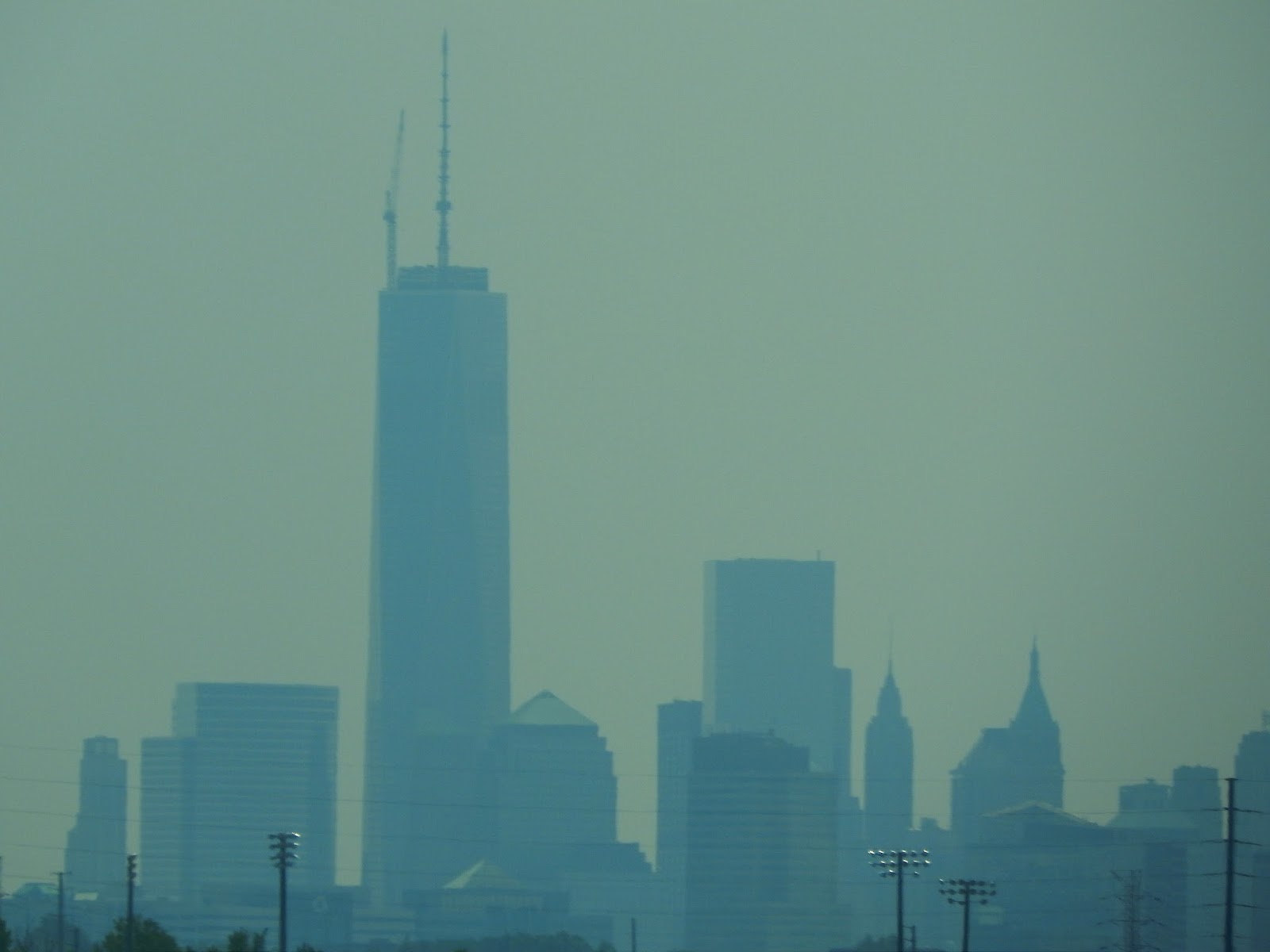
After spending nearly five hours traveling through Maine, Massachusetts and Connecticut, we picked up I-95 again just outside Stamford. Before we reached the George Washington Bridge, we waded through a traffic jam on the Bronx Expressway. The GW was under going repairs and drivers were paying the price. When you see the GW in person, you will be in awe of this engineering feat. Thousands of automobiles pass over this super structure that crosses the Hudson River. The toll won't put a dent in your pocket, but it will make your jaw drop when you shell out $13 to cross the Hudson. The GW was completed in 1931. The toll is a small amount to pay to pass over this behemoth and an opportunity to take a quick glance at a metropolis ― New York City.

The Ben Franklin Bridge
We crossed many small bridges in our travels, but besides the GW Bridge, two are really unforgettable. Tourists must cross the Ben Franklin Bridge (completed in 1926) for $5 to get to Philadelphia, but it is another modern marvel and gives you a wonderful view of the city's tall buildings. The Susquehanna River Bridge is special because it crosses that mighty river. We raced over it on our way to Gettysburg.

Walking distance

Staying at the Wyndham hotel turned out to be a wise decision, not because of the price, either. The building was smack dab in the middle of everything we wanted to see. Driving in downtown Philly would make any Mainer long for the empty back roads of the Pine Tree State.

Good food at Philadelphia's Bourse
The first thing we did after our arrival was visit and dine at the Bourse, which means a place of exchange. It is a tall, red building that features stores and several places to sample's Philly's food, although I refused to try a Philly cheese stake. These three hungry souls ate at the Liberty Chicken where a kind, elderly gentleman served three weary travelers just before the Bourse closed. It was a scrumptious meal. The Bourse is similar to Faneuil Hall in Boston, but is unique in its own way.

The next day, we fanned out all over downtown Philadelphia. We were just a block away from Independence Hall and the Liberty Bell, but before we dropped in on those two historic sites, we visited Ben Franklin's grave. He lies just behind the Wyndham hotel. There is a tradition of putting pennies on Franklin's grave. Franklin often said: "A penny saved is a penny earned." Terri gave more than just a couple of pennies after change went flying from her open purse. I bet old Ben didn't mind a bit.

Inside Independence Hall
After paying our respects to Mr. Franklin, we marched off to the Independence Visitors Center to pick up tickets for a tour of Independence Hall. We were going to visit the Liberty Bell first, but fire alarms went off and we were forced to evacuate the building. But we did get our tickets and headed over to Independence Hall. A U.S. Park Service guide gave visitors a lecture about the hall and the signers of the Declaration of Independence. Walking through these halls and realizing 56 men committed treason when they signed that document gave me a greater appreciation of their determination. They were from different backgrounds with one cause in mind ― establishing a government where all men are created equal. Many of them paid a heavy price after making a commitment to create a new nation. A few signers were tortured by the British and others lost their wealth after the war and died in poverty. They were amazing men with a vision that came to fruition because of their unwavering commitment, devotion and sacrifice.

We made a change of plans and walked down Pierce Street toward Penn's Landing, which is the waterfront area of Philadelphia and named after the founder of Pennsylvania ― William Penn. 

Before we arrived at Penn's Landing, we toured Carpenter's Hall, which was the meeting place for the first Continental Congress. It is like many brownstones in the historic district, and inside, it is an elegant building with high ceilings.

Inside the Independence Seaport Museum
Our next stop was a stroll to the Delaware River and tour the Independence Seaport Museum and the Spanish-American War-ear cruiser U.S.S. Olympia and World War II-submarine U.S.S. Becuna, which are docked next the Seaport Museum that maintains these two sea-going titans. If you are fascinated with maritime history and sea exploration, the museum's numerous exhibits will expand your knowledge and satisfy your curiosity.

Inside the torpedo room of the U.S.S. Becuna
Anthony's passion for ships and the Maritimes started when he was two years old. He sparked a dream to stand on the decks of the Olympia. His fascination with this pre-dreadnaught U.S. warship has been inspiring. He even built of a model of Dewey's ship. After a long lunch at the Marriott, we headed out in the summer heat. The temperature was hovering around an unbearable 96 degrees. Most of the Northeast was simmering in an unrelenting heat wave. We boarded the Becuna in the searing sun and went below. It was cooler in the submarine, but squeezing through doorways that measured three-and-half feet was excruciating for a man of my size, but seeing the torpedo and engine room made all that deep-knee bending worth it. I will never understand how they get fine men and women to go down in those iron monsters. The narrow openings made me feel like mashed tuna in a can.


An hour later and we climbed aboard the U.S.S. Olympia ― Admiral George Dewey's flagship during the battle of Manilla Bay where his fleet wiped out the Spanish navy. This American cruiser is not a replica, but an actually seagoing piece of history that survives to this day. The museum does a commendable job keeping this ship float. It takes a great deal of money to prevent this wonderful piece of America's history from being scraped or moved to another part of the nation.

What makes this ship unique is its luxurious inside, with its mahogany walls and elegant furniture. Today's warships feature spartan rooms. Dewey travelled in style on his protected cruiser, which is armed with four eight-inch and several five-inch guns and other small armaments. During the battle of Manilla, Dewey uttered the famous phrase, "You may fire when you are ready, Gridley."
Anthony and I often talked about visiting the Olympia. For several years, it was only a dream, but on July 16 a father and son strolled its decks and photographed every inch of this heroic protected cruiser. Some dreams do come true, and I was fortunate to tour this vessel with my son.
We saluted Dewey's ship and left Penn's Landing in dangerous heat. It was a mile back to the hotel, but at the risk of suffering of heat stroke, we hailed a cab. We caught a driver's attention and he pulled over to pick up three sweaty tourists. Our driver was a man named Ali who was originally from Pakistan. He was pleasant and accommodating. 

"I was hesitant to stop," said Ali. 

"It was written," I told him. We both laughed.

We arrived at the hotel. I told Ali was I grateful that he stopped to give us a lift.

"You are a very entertaining man and you have a lovely family," Ali said.

"That bought you a really good tip," I said.

"Thank you. You are kind," Ali said.

We took a dip in the pool before he headed out for the evening to visit a cosmetic store for Terri and then find the SS United States, the largest passenger ship ever built in this country. It was constructed in 1952. The United States could also be converted to a troop ship in time of war. It is now docked in Philadelphia where money is being raised to restore this monstrosity. And there it was, towering over buildings and looking pretty beat up.

We found the makeup store after an hour search in the financial district. From there, we drove back to Penn's Landing and travelled along the waterfront to find the United States. We took pictures of the beat-up ship that carried celebrities around the world during its heyday. It is one big bastard, and I think worth preserving.


"The last full measure of devotion."

It wasn't a last-minute decision. We visited Philadelphia knowing we would spend an entire day on the battlefields of Gettysburg. We were only 132 miles from that city that is nestled in the Allegheny Mountains. I consider Anthony an authority on this epic, three-day battle even though he is a junior in high school. We have watched "Gettysburg" a number of times. But staring out over those open fields and knowing that men on both sides faced withering gunfire and cannon made me realize that no history lesson can bring to life the horror and slaughter that soldiers confronted on the battlefield.

We travelled along the Pennsylvania Turnpike and passed through Lancaster, also know as Amish Country. My wife has a fascination with the Amish, which I can't explain.

Before you make numerous stops on the tour, tourists should check in at the Gettysburg National Military Park Museum and Visitor Center to get your bearings and put a dent in your wallet at the gift shop. But it is worth forking over the $50 to see "A New Birth of Freedom," narrated actor Morgan Freeman, and the Gettysburg Cyclorama, which is a huge, circular painting of Pickett's Charge.

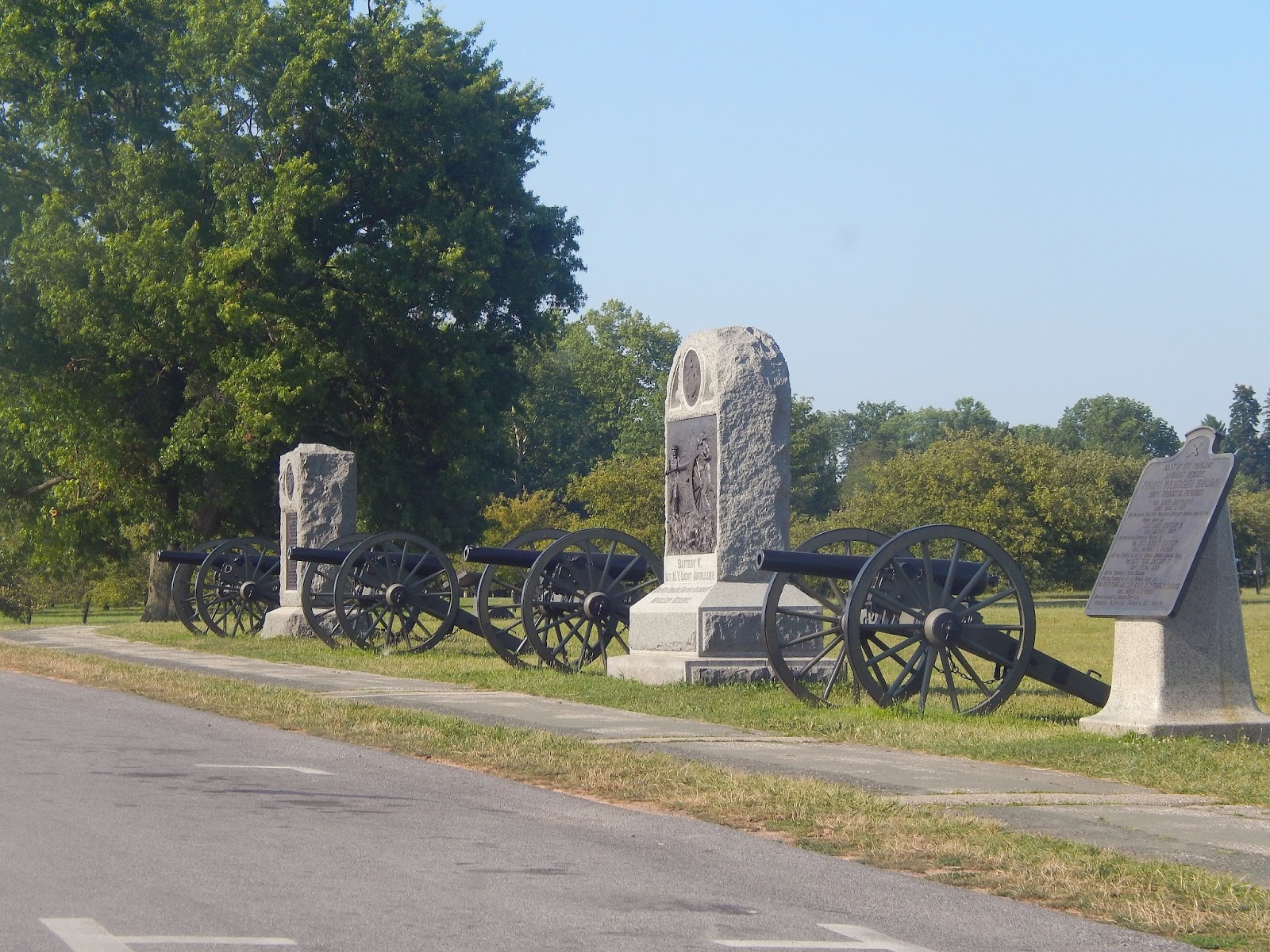
We took the car tour and made dozens of stops to read the monuments, which included a huge stone figure that marked the spot where Union Gen. John Reynolds fell after being killed by a Confederate sniper We climbed two observatories that overlook the battlefields in the intense heat. Little and Big Roundtop are clearly visible from one of these towering, iron platforms. But if you hate climbing stairs in the summer heat, you might be better off keeping your feet on the ground and remain in an air-conditioned car.

This family from Maine visited Little Roundtop where Maine Congressional Medal Honor Winner Gen. Joshua Chamberlain and the 20th Maine turned away the Rebels with a bayonet charge with empty muskets. The 20th was out of ammunition but would not reliquish the high ground and allow the Rebs to sweep around the Union lines. Chamberlain was also a four-term governor of the Pine Tree State and president of Bowdoin College. His home is in Brunswick, Maine, and is still open to the public. Visiting Little Roundtop meant running into Maine Gov. Paul LePage. Go figure! He was there, along a group of servicemen, honoring the 20th Maine, but one of the soldiers did thank us from coming all the way from the Pine Tree State to honor Chamberlain's heroes.

We spent six hours at the park, but I believe it really takes an entire day to appreciate what transpired at Gettysburg.

The voyage home

It was difficult leaving Pennsylvania, but we accomplished an objective to visit the Olympia and Gettysburg. I often thought of my mother as we passed through the Allegheny Mountains. My mom spent many summers in Waterford, Penn. I am lucky I had two fine people to tour Philadelphia. We raced home and stopped off to visit my sister in central Massachusetts. Nothing like a home-cooked meal and a visit with family to give us a much-needed break from all that driving.

I guess I would suggest to all Americans, especially this Congress, to visit Philly, stand on the decks of the U.S.S. Olympia, wander Independence Hall and take a picture beside the Liberty Bell. 

Why? 

These national treasures are reminders of a nation that was created when 56 remarkable men demonstrated their audacity and courage to create a better world for the greater good and go on to forge the greatest living document in the world ― the United States Constitution. Like our Constitution, America is still and always be a work in progress.

And to think all it took was a 1,200-mile road trip and an opportunity to rock the Cradle of Liberty to remind ourselves that we are indeed a nation of hope.


Out and about

Take a walk on the wild side around New England's outdoors. Come walk with my son and I as we explore state parks, historic sites, and creepy cemeteries. This is the good stuff in life, and there is nothing worth watching on television, anyway. Join us as we take advantage of Maine's beaches and pristine forests. In between our sojourns through the Pine Tree State, look for political insight and a few well-written opinion pieces as well.